
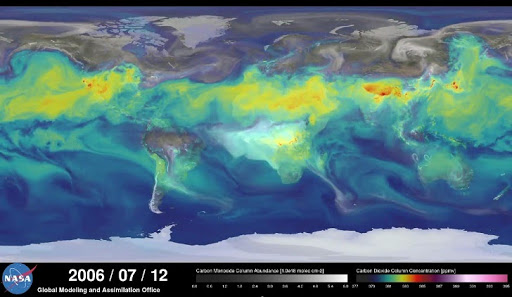
Scientists project a global temperature increase from 1.5°C to 2°C by the end of the century. This could change life as we know it!
You might be wondering: How do scientists come up with these numbers?
Modeling GHG
Scientists use tools called Global Climate Models (GCMs) to study Earth’s climate.
Think of a model as a giant computer program that represents how our planet works. It includes processes such as the water cycle, melting ice, solar energy from the Sun, winds, and ocean currents.
These processes are represented as mathematical equations that computers can solve.
Scientists then add greenhouse gases into the models to learn what might happen in the future.
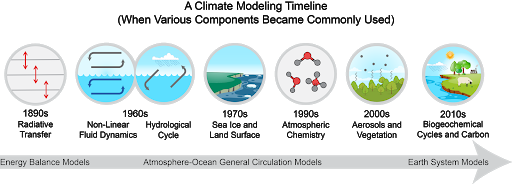
Today, more than 35 models have been created by organizations around the world.
Researchers run the same set of information through each of the models and compare the results.
Understanding the Model's Results
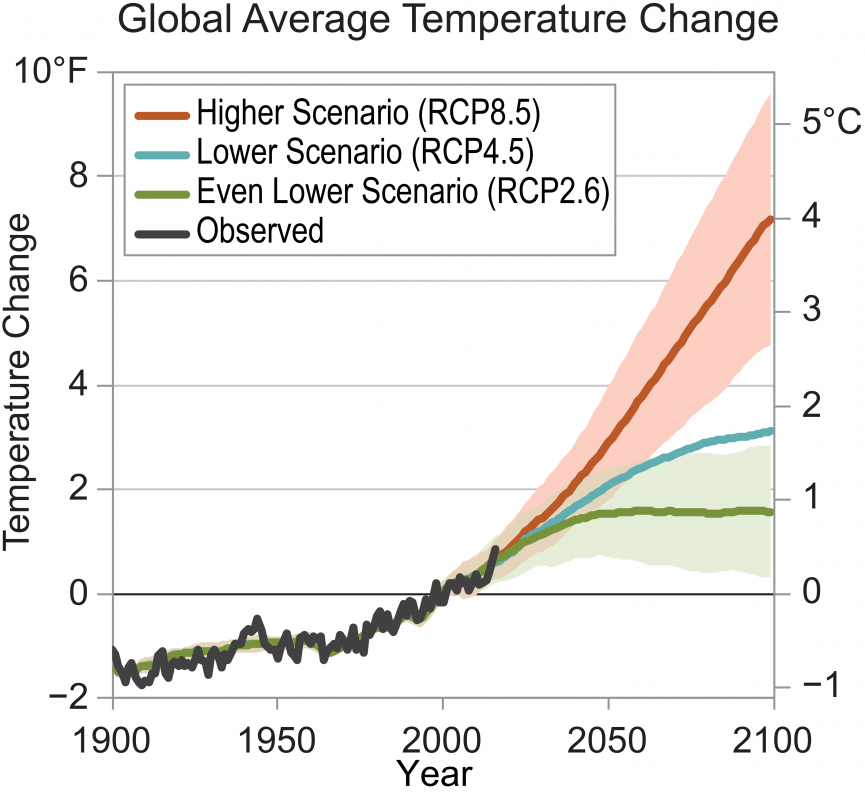
Scientists ask questions such as: What could happen if we reduce greenhouse gas emissions? Or increase them? Or keep them the same?
The reason scientists model each of these scenarios is because the future is unknown.
Countries may adopt renewable energy sources, people may choose to eat more plant-based foods, or new technologies could reduce emissions. If not, emissions could go up.
What do the results of the models tell us?
- The increase in surface temperature from 1970 to 2016 was close to what was actually observed.
- If we remove human causes, natural factors alone cannot explain the temperature increase we see today.
- We need to reduce greenhouse gases by a large amount if we want to keep the average temperature rise within 1.5°C to 2°C by 2100. If we don’t, we could see a temperature increase of as much as 4°C.
How Accurate are the Models?
A small amount of uncertainty is always a part of science. Our Earth is a complex system and modeling clouds and jet streams is challenging. There could be sudden changes in ocean circulation or a collapse of Antarctic glaciers that could affect results.
Scientists are constantly improving the models as our knowledge of climate science and technology increases. However, there is no doubt that human activity is changing our climate in unnatural ways.
In the next module, let us look at the impact of climate change!
Summary
- Scientists add greenhouse gases into the climate models to simulate what might happen in the future.
- They simulate different scenarios by asking questions such as: What might happen if we reduce greenhouse gas emissions? Or increase them? Or keep them the same?
- The models show that to keep our Earth's temperature rise to within 1.5°C to 2°C by 2100, greenhouse gas emissions need to be cut drastically.
You may have heard projections that Earth's temperature could rise by 1.5°C to 2°C by the end of this century, and that this could change life as we know it.
But how do scientists arrive at these numbers?
Modeling Greenhouse Gases
Scientists use tools called Global Climate Models (GCMs) to study Earth’s climate (explained HERE).
Think of a model as a giant computer program that represents how our planet works. It includes processes such as the water cycle, melting ice, solar energy from the Sun, winds, and ocean currents—all of which are represented as mathematical equations that computers can solve (Fig. 3.6.2).
Next, scientists add greenhouse gas levels into the models to project what might happen in the future.
Today, there are more than 35 GCMs that have been developed and maintained by institutions globally. Researchers run the same data through multiple models and compare the results to identify patterns.
Understanding Results
Since the future depends on the choices people make today, scientists test different scenarios, also known as “emission pathways”.
They ask -- What would happen if we cut emissions? What if we keep them the same? What if they keep rising?
For example, if countries switch to renewable energy sources, increase their consumption of plant-based foods, or adopt new technologies, emissions could decrease. If not, they could go up.
So, what do the results show?
- From 1970 to 2016, the models’ predictions matched the actual rise in temperature.
- If we remove human causes, natural factors alone cannot explain today’s warming.
- All models agree: to limit global warming to 1.5°C–2°C by 2100, greenhouse gas emissions must fall drastically. Without reductions, the average global temperature could rise by as much as 4°C.
How Accurate Are The Models?
Like all science, climate modeling involves some uncertainty.
Our Earth is a complex system, and modeling clouds and jet streams is challenging. There could be sudden shifts in ocean circulation patterns (such as the El Niño–Southern Oscillation) or the collapse of Antarctic glaciers, which can affect the model's outcomes.
Scientists continually refine models as our understanding of climate systems deepens and computing power increases. However, despite some uncertainty, there is no doubt that human activity is changing Earth’s climate in unnatural ways.
In the next module, we will look at what these changes mean for ecosystems and human society.