
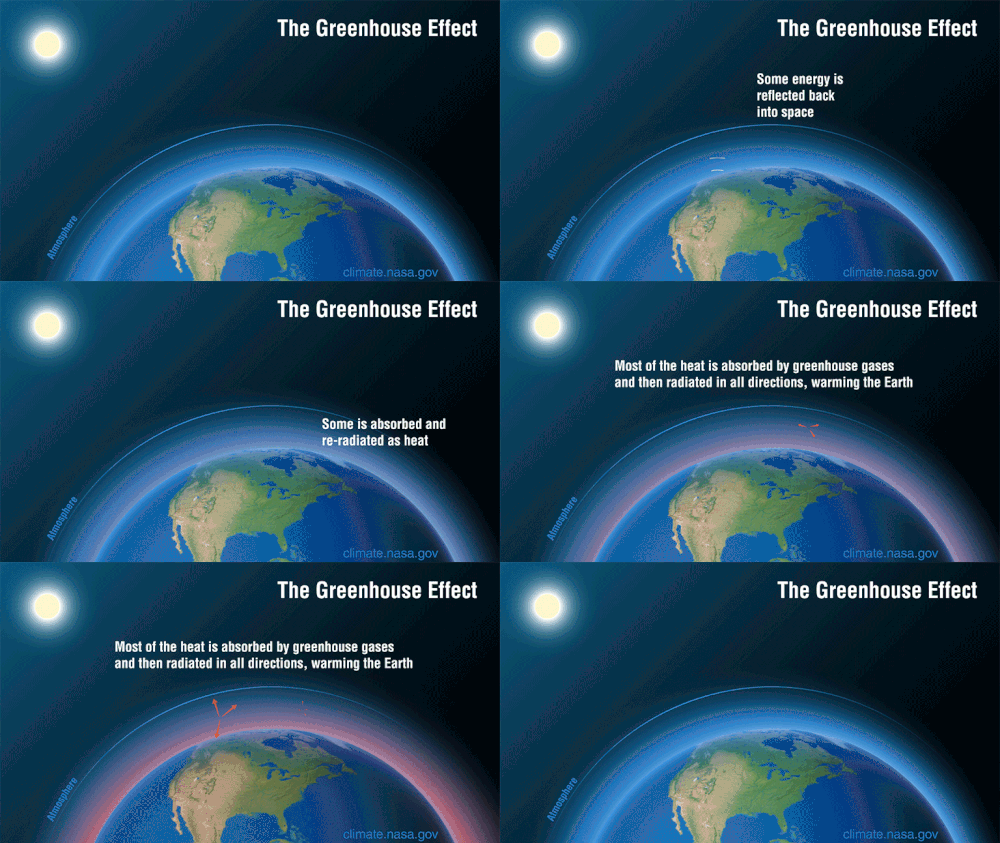
Have you ever wondered what happens to the Sun’s energy when it reaches the Earth?
Some of this energy is reflected back into space, and the rest is absorbed by the Earth. The absorbed energy is sent as heat back into the atmosphere.
Gases such as carbon dioxide and methane absorb this heat energy and send some of it back towards the Earth’s surface. The rest escapes into space.
As the heat energy bounces back and forth, it keeps the Earth at a temperature that is just right to sustain life. This is known as the Greenhouse Effect.
The main gases responsible for the greenhouse effect are carbon dioxide (CO2), methane (CH4), nitrous oxide (N2O), ozone (O3), and water vapor. Hence, they are known as greenhouse gases.
Did you know that without greenhouse gases, Earth’s temperature would be 0°F (or -18°C)?!
Turning Up The Heat
By the late 1800s, scientists started to notice that fossil fuels used by humans were releasing greenhouse gases.
About a hundred years later, scientists proved the connection between greenhouse gases and global warming.
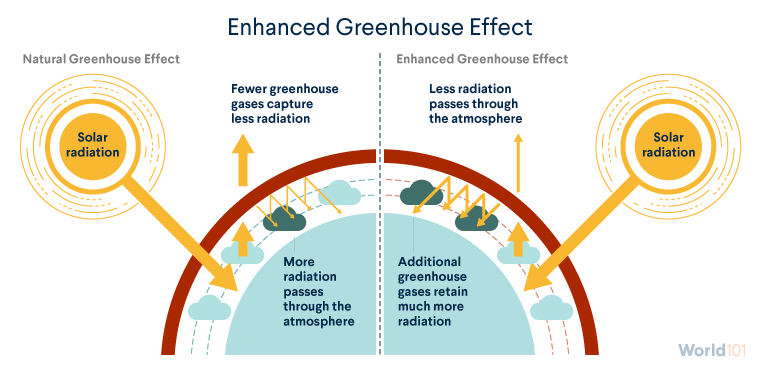
Now we know that just as a thicker jacket keeps us warmer, a thicker layer of greenhouse gases traps more heat in the lower atmosphere (see figure below).
The Big Question
Can greenhouse gases explain the observations by scientists that we learned about in the Data section? Yes, it does!
The heat trapped by greenhouse gases causes Earth's surface and ocean temperatures to rise.
Rising surface temperatures cause more water to evaporate, which changes rainfall and snowfall patterns.
Rising surface and ocean temperatures cause glaciers and ice sheets to melt faster. Water expands when it is heated. So with the combination of ice melting and water warming, the sea levels are rising.
When carbon dioxide dissolves in water, it forms a weak acid. So increasing levels of this greenhouse gas make our oceans more acidic.
Now that we know greenhouse gases are the culprits, let us learn about their sources in the next section.
Summary
- The Sun's energy is trapped by gases in our Earth's atmosphere through a process known as the greenhouse effect.
- Greenhouse gases make up less than 0.03% of the atmosphere. They make life possible on Earth.
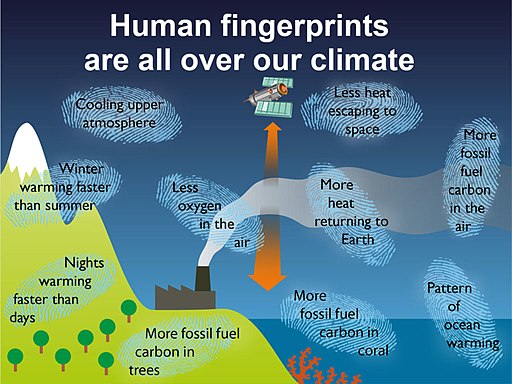
- Scientists have concluded that greenhouse gases released from human activity are responsible for the unusual warming we see today.
We examined natural factors that affect our Earth’s climate and concluded that they do not explain the rate of warming we observe.
Before we delve deeper to find the culprit, let’s first understand what happens to the Sun’s energy when it reaches Earth.
Some of this energy is reflected back to space by the clouds and the atmosphere, and the rest is absorbed by the Earth. The absorbed energy is sent as heat (infrared radiation) back into the atmosphere. Gases such as carbon dioxide and methane absorb the heat energy and radiate some of it back towards the Earth’s surface. The rest escapes into space.
This constant movement of heat between the Earth's surface and the atmosphere keeps our planet's temperature within a range that is suitable for life.
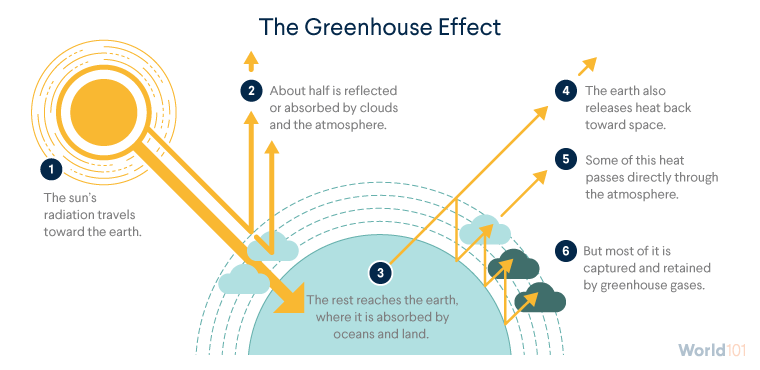
This process, known as the Greenhouse Effect, was first identified by French scientist Joseph Fourier in 1824 and later confirmed by British physicist John Tyndall in 1859.
The main gases responsible for the greenhouse effect are carbon dioxide (CO₂), methane (CH₄), nitrous oxide (N₂O), ozone (O₃), and water vapor -- hence known as greenhouse gases. Without greenhouse gases, Earth’s average temperature would be about 0°F (-18°C) instead of the much more livable 59°F (15°C)!
Turning Up The Heat
By the late 1800s, scientists realized that humans were adding greenhouse gases to the atmosphere by burning fossil fuels.
In 1890, Swedish chemist Svante Arrhenius was the first to calculate how rising CO₂ levels could increase temperatures. By the mid-1900s, researchers such as Guy Callendar and Charles David Keeling provided further proof of the connection between greenhouse gases and global warming.
Today we understand the effect clearly: just like a thicker jacket traps more body heat, a thicker layer of greenhouse gases traps more heat in Earth’s atmosphere (Fig. 3.3.2).
The Big Question
Can the presence of additional heat-trapping greenhouse gases (GHGs) explain the changes in Earth's climate as discussed in the Data section? As it turns out, they do.
- The extra heat causes Earth's surface temperature to rise, as well as makes the oceans warmer (Changes in Surface Temperature, Changes in Oceans).
- Higher surface temperatures cause more water to evaporate from land and oceans, which changes rainfall and snowfall patterns (Changes in Precipitation).
- Rising surface and ocean temperatures cause glaciers and ice sheets to melt faster (Changes in Cryosphere)
- Water expands when it is heated. The combination of ice melting and water warming causes sea levels to rise (Changes in Sea Level)
- When carbon dioxide dissolves in water, it forms a weak acid. Hence, increasing levels of this greenhouse gas make our oceans more acidic (Changes in Oceans)
We feel the impacts of these as more frequent extreme weather events, disappearing coastlines, food insecurity, and more.
Now that we know greenhouse gases are the main culprits, let’s take a closer look at their sources in the next section.