
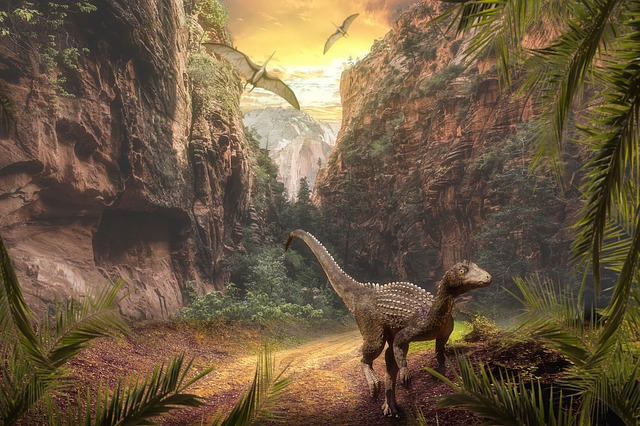
We know that when dinosaurs ruled Earth, our planet was extremely hot. There was no ice on Earth and forests grew in Antarctica! We called this Greenhouse Earth.
During Greenhouse Earth, there were very high levels of gases such as methane and carbon dioxide in the atmosphere.
After Greenhouse Earth, we had a period of cooling called Icehouse Earth. During this time polar ice sheets and glaciers formed and there were lower levels of carbon dioxide and methane in the atmosphere.
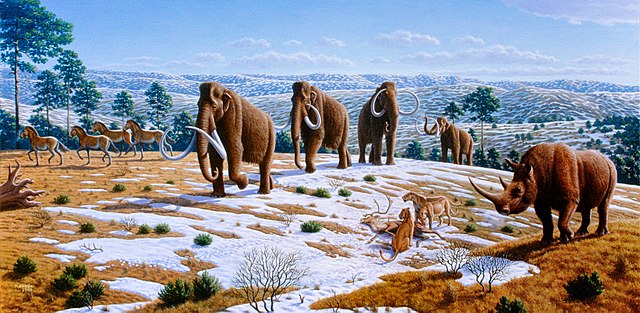
Icehouse Earth is divided into periods of glacial cycles and interglacial cycles. The last time that glaciers formed, woolly mammoths, saber-tooth tigers, and giant sloths roamed our planet.
Yes, giant sloths!
We are currently in the interglacial cycle which began 11,500 years ago.
Comparing Temperature Changes
Usually, the changes from glacial to interglacial periods take 10,000 to a few 100,000 years. The temperatures rise from about 7ºF to 13ºF during this time. This slow change lets our planet and species adapt to the changes.
Over the past 10,000 years, temperatures have been stable. This very special window of time has let human civilizations flourish!
Scientists tell us that our Earth should be cooling now, as part of its natural cycle. However, we are seeing the opposite happen.
Surface temperatures have been rising by 1.8ºF (1ºC) in just the past 150 years. Land and ocean temperatures have been increasing at a rate of 0.32ºF per decade.
This change tells us that Earth is warming at a much faster rate.
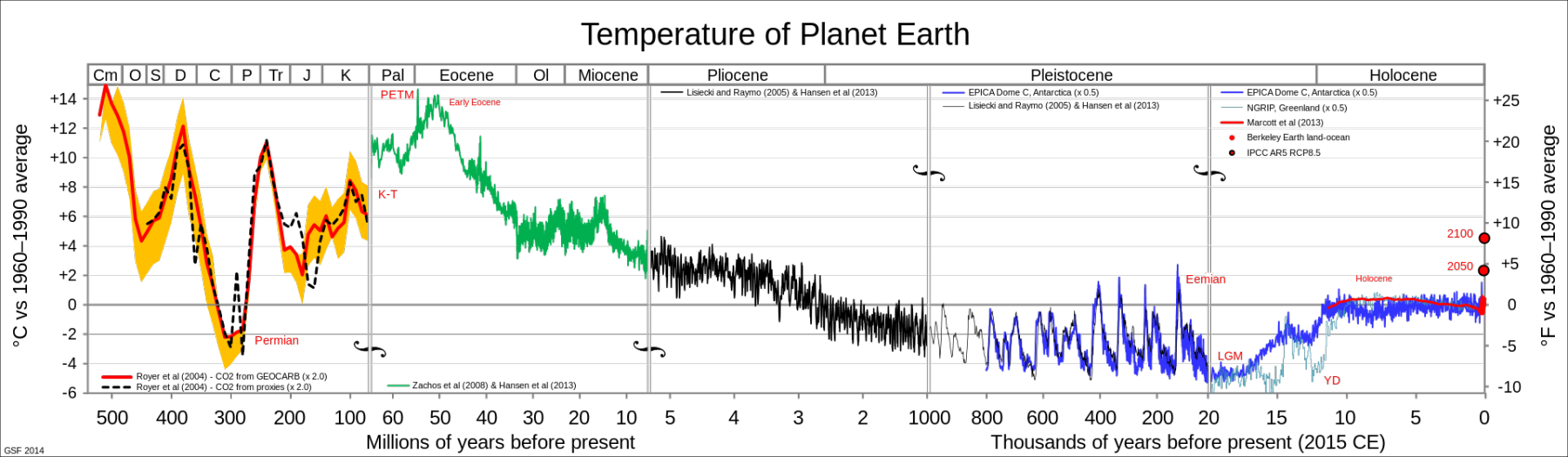
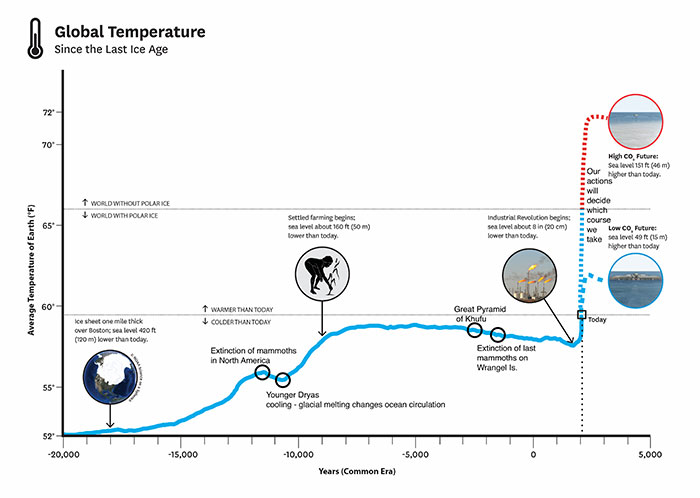
Figure 3.1.3 shows temperature changes over the past 500 million years. Figure 3.1.4 shows the average temperature over the last 20,000 years. Notice how farming and human civilizations developed in the last 10,000 years.
Summary
- Our Earth has gone through periods of intense heat and cold, known as Greenhouse Earth and Icehouse Earth.
- Over the past 10,000 years, temperatures have been stable, allowing human civilization to flourish.
- Based on Earth's natural cycle, our planet should be cooling down. Instead, temperatures are rising at a much faster rate.
When dinosaurs roamed the Earth, our planet was much hotter and covered with lush vegetation. There was no ice on Earth, and even Antarctica was forested!
This period is known as the “Greenhouse Earth” and was marked by very high levels of gases such as methane and carbon dioxide in the atmosphere.
Earth has gone through several Greenhouse phases, with the most recent lasting from 250 to 66 million years ago.
Greenhouse Earth was followed by a long period of cooling, which led to the formation of polar ice sheets and glaciers. During this cooler phase, known as Icehouse Earth, carbon dioxide and methane levels in the atmosphere were much lower.
Within Icehouse Earth, there have been cycles of glacial periods (times of widespread ice growth) and interglacial periods (warmer phases with shrinking ice). During the last glacial period, woolly mammoths, saber-tooth cats, and giant sloths roamed the planet!
We are currently living in an interglacial period that began about 11,500 years ago.
Comparing Temperature Changes
Based on paleoclimate records, scientists estimate that Earth warmed by about 7ºF to 13ºF from the peak of the last glacial period to the warmer interglacial phase.
These glacial-interglacial cycles usually last 10,000 to several hundred thousand years. The slow rate of temperature change allows Earth’s chemistry, species, and ecosystems to gradually adapt to the changing environment.
For the past 10,000 years, global temperatures have remained relatively stable, creating conditions that allowed human civilizations to flourish.
But here is the surprising part – based on Earth's natural cycles, we should be entering the cooling phase of the interglacial cycle. However, the Earth is warming.
- Global average surface temperatures have risen by about 1.8°F (1°C) in just the past 150 years.
- Since 1981, combined land and ocean temperatures have been rising by 0.32°F per decade. This is more than double the rate of 0.13°F per decade observed between 1880 and 1980.
- This rapid pace shows that not only is Earth warming, but it is doing so much faster than natural cycles alone would predict.
Fig. 3.1.3 shows global temperature changes over the past 500 million years compared to the 1960–1990 average (the zero line). Fig. 3.1.4 shows the average temperature over the last 20,000 years – notice how farming and human civilizations developed in the last 10,000 years.