

Since oceans cover 70% of our planet, they play a very important role in regulating Earth's climate.
They absorb heat energy from the sun and the atmosphere and slowly release it over long periods of time. Thus, they keep our planet warm.
This heat energy is circulated by waves and tides, and by ocean currents from warmer to colder regions of our planet and deeper into the ocean.
Oceans also store carbon. They absorb carbon dioxide from the atmosphere, which is used by phytoplankton for photosynthesis. Carbon dioxide also dissolves in water to form a weak acid.
Hence, heat content, acidity, and salt content (salinity) represent the health of our oceans. Ocean health is important because it affects ocean currents and the marine species that have adapted to the conditions over millions of years.
How Is Ocean Health Measured?
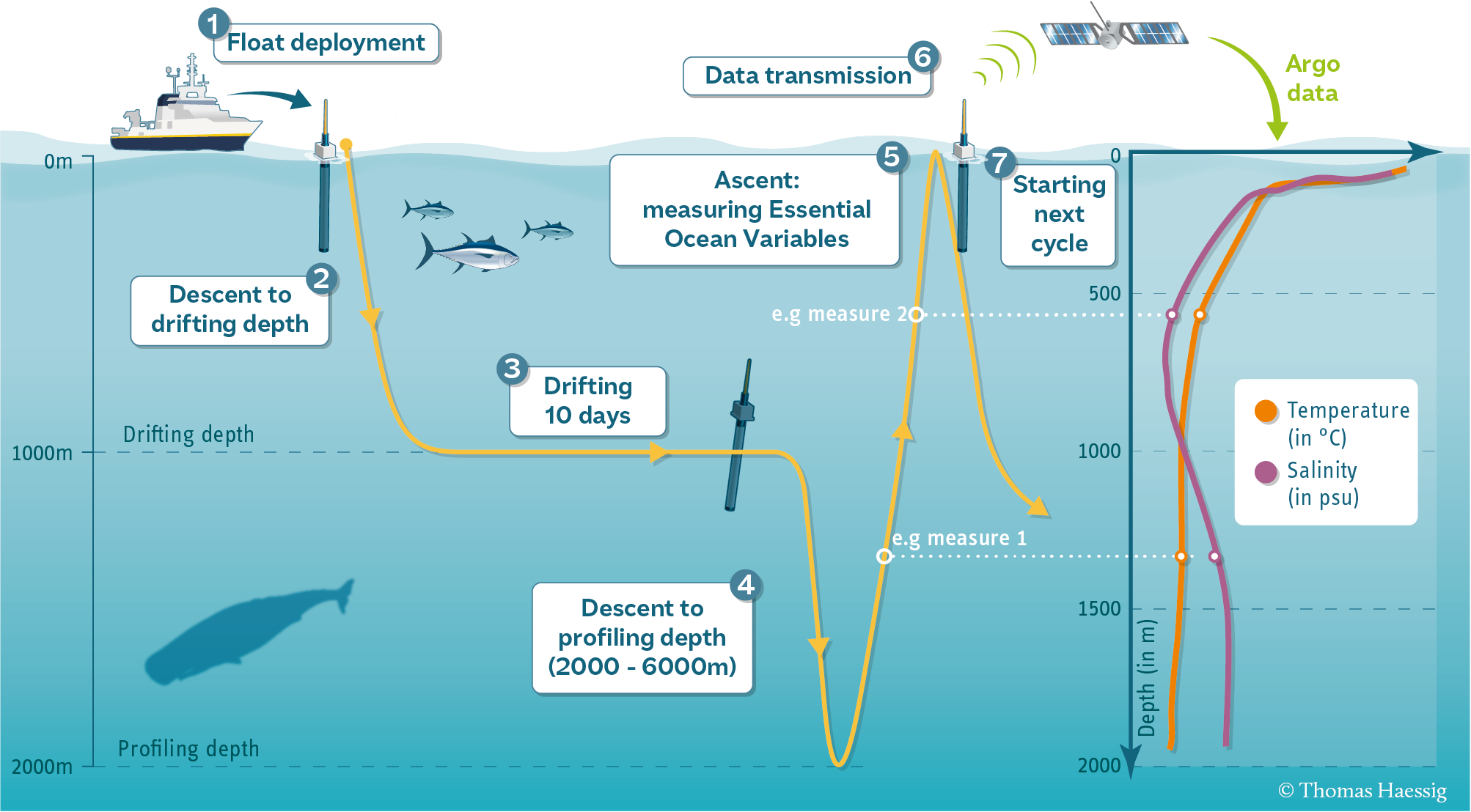
Scientists use buoys that float and sink at different levels under the ocean’s surface. Every ten days, the buoys dive to depths of 2000 meters. Then they slowly rise up to the surface.
As they rise, the little floating robots (known as Argo floats) measure the temperature, salinity, and acidity at each depth. They send the information using satellites to stations on land. There are close to 4,000 floats around the world!
Satellites are also used to track ocean salinity. They measure microwave light emitted by the water surface.
What Does the Data Tell Us?
It turns out that our oceans are warming up!
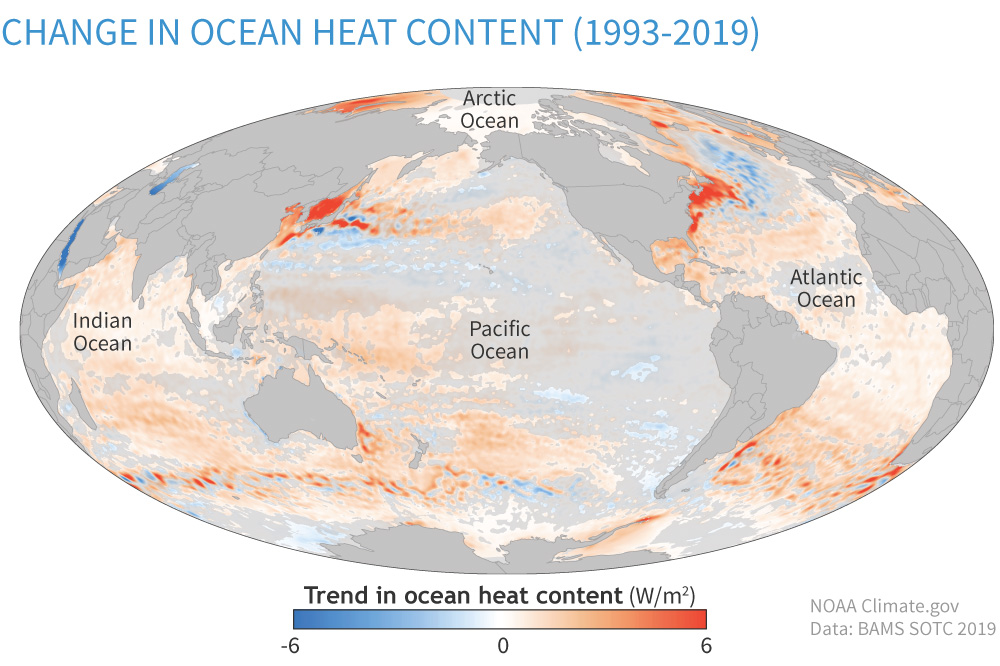
Nearly two-thirds of the increase in heat energy is stored in the upper 700 meters of the ocean. Of this, the top 75 meters have warmed the most at a rate of 0.1ºC per decade since 1971.
Figure 2.3.4 shows changes in heat content in the oceans. Areas getting hotter are shown in red, and those that are cooler are in blue.
Scientists have also learned that the acidity of water in the oceans has gone up significantly - by almost 30%!
Salinity is another marker of ocean health. It is changing too. Usually, salinity changes regularly due to evaporation, precipitation, and the formation and melting of sea ice.
Measurements show that in polar regions and tropical areas where there is more rainfall, ocean waters are becoming fresher. However, in the subtropical regions where there is more evaporation, ocean waters are getting saltier.
So now we know that the oceans are getting warmer, more acidic, and slightly more salty. Let’s learn about the ice on our planet next!
Summary
- The health of our oceans is measured by temperature, salinity, pH, and dissolved gases in water.
- Data shows that our oceans are warming up, with most of this heat stored in the upper 700 meters.
- The ocean has become more acidic, and some areas are getting saltier while others, fresher.
Since oceans cover more than 70% of the Earth’s surface, they play a crucial role in regulating the global climate.
Oceans absorb an enormous amount of heat energy from the sun and the atmosphere, keeping our planet warm. This is because water has a high heat capacity – in other words, it can store a lot of heat before its temperature rises.
Waves, tides, and ocean currents move this heat around from the equator towards the poles and into deeper waters. Without these currents, the equatorial regions would become extremely hot while the polar regions would be far colder.
The stored heat is slowly released back into the atmosphere through evaporation, melting ice, and direct transfer from the ocean’s surface.
Oceans are also a major carbon sink. They absorb carbon dioxide from the atmosphere, some of which is used by phytoplankton for photosynthesis. The rest dissolves in water, forming a weak acid that makes our oceans slightly acidic.
Hence, the three key indicators of ocean health are its heat content, acidity, and salinity. Ocean health matters because it influences currents and the marine ecosystems that have evolved over millions of years.
How Is Ocean Health Measured?
To monitor these conditions, scientists use a global network of about 4,000 drifting Argo floats (Fig. 2.3.2).
These probes usually remain 1,000 meters below the ocean’s surface. But every 10 days, they adjust their buoyancy, dive to depths of 2,000 meters, and then rise to the surface.
As they ascend, they measure temperature, salinity, acidity, and oxygen and nitrogen levels at different depths. The data is transmitted via satellites to the World Meteorological Organization (WMO).
Satellites also help track ocean salinity by measuring microwave radiation from the sea surface.
What Does the Data Tell Us?
The data reveal that our oceans are warming. Nearly two-thirds of the extra heat energy is stored in the upper 700 meters. The top 75 meters of the oceans are warming the fastest—about 0.1ºC per decade since 1971.
Figure 2.3.3 highlights these changes, with red areas showing warming and blue areas showing cooling.
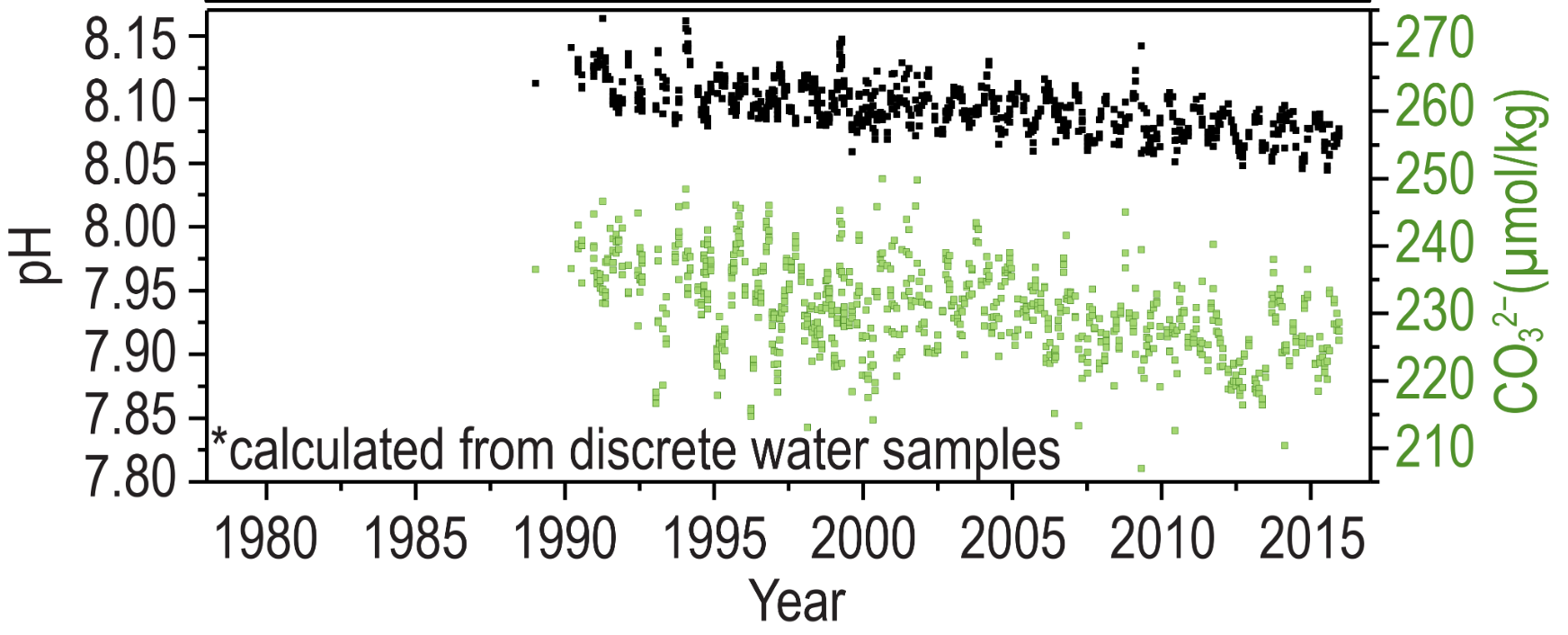
In addition, the oceans are becoming more acidic as measured by the pH scale.
Since the start of the industrial age, the average ocean pH has dropped from 8.2 to 8.1 (Fig. 2.3.4). Though this change seems small, a 0.1 decrease in pH actually represents about a 30% increase in acidity!
Finally, salinity patterns are shifting. Normally, salinity changes with evaporation, precipitation, and sea ice formation and melting.
Measurements show that in polar regions where ice is melting, and in tropical regions that receive heavier rainfall, ocean waters are becoming fresher. Meanwhile, in the subtropical regions where there is more evaporation, ocean salinity is increasing.
We’ll explore the reasons behind these changes in Module 3. For now, let’s move on to examine Earth’s frozen regions, known as the cryosphere, and how they are responding to climate change.