
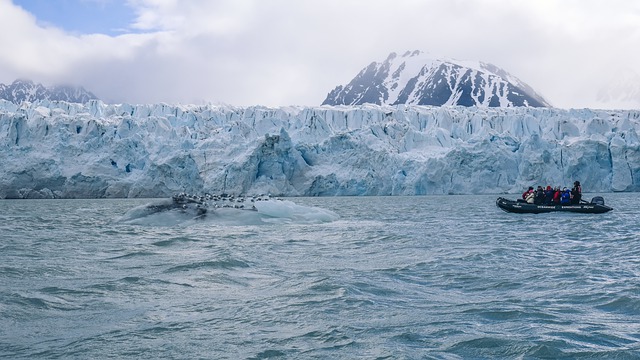
The “cryosphere” is the frozen area of our planet. This includes land ice and sea ice.
Some examples of land ice include glaciers, permafrost, ice sheets, and frozen lakes and rivers.
Sea ice is frozen ocean water. It forms, grows, and melts back into the ocean.
What makes up the Cryosphere?
Did you know that - About 70% of Earth’s drinkable water lives in the cryosphere.
The cryosphere is home to many species, such as polar bears, snow leopards, seals, penguins, and many types of birds.
Ice and snow reflect more heat and sunlight back into space. So that means, the cryosphere maintains Earth’s temperature and keeps it from getting too hot.
How Is The Cryosphere Measured?
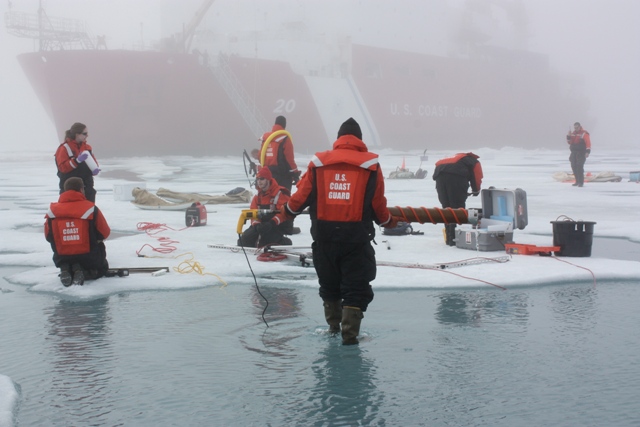
Satellites measure the changing heights of glaciers and ice sheets with lasers. Yes, actual lasers! They point a laser beam at the ice sheet and wait to see how long it takes to bounce back. When land ice melts or grows, the satellite records the change.
Also, when ice sheets melt, the satellite records a little less gravitational pull from the ice. This tells scientists how much ice mass has been lost.
To get a closer look at the cryosphere, scientists set up research stations in the Arctic and Antarctica. They measure the thickness and temperature of ice, ocean currents, ice movement, the rate of ice formation, and more. They also study sea ice using special ships equipped with icebreakers. Icebreakers travel with the sea ice and record information about the environment.
Finally, floating buoys carrying sensors record data and transmit it to land.
What Does the Data Tell Us?
In Antarctica and Greenland, ice sheets are losing mass. According to NASA, between 2003 and 2019, Greenland’s ice sheet lost an average of 200 gigatons of ice per year, and Antarctica’s ice sheet lost an average of 118 gigatons of ice per year.
The winter Arctic sea ice cover is shrinking at an average rate of 3.1% per decade.
Usually, Arctic sea ice reaches its minimum in September and grows again during the winter. The minimum sea ice cover in September is decreasing at an even faster rate of 13.4% per decade!
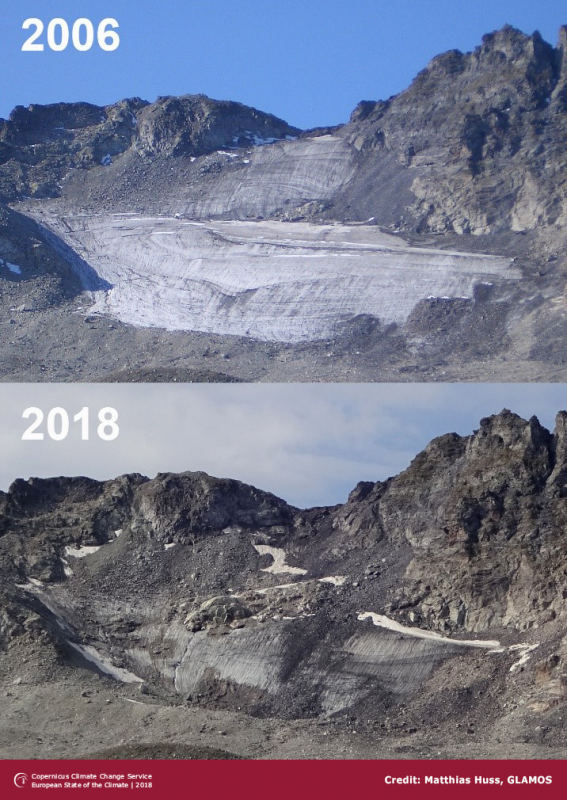
However, it is not just sea ice and ice sheets that are declining. Alpine glaciers in central Europe, western Canada, the U.S, New Zealand, and near the tropics are disappearing as well.
Now that we have examined the extensive changes in the cryosphere, let’s look at how sea levels are changing next.
Summary
- The cryosphere is important because it contains 70% of our world's freshwater.
- It maintains the Earth’s temperature by reflecting the sun's heat back into space.
- The thickness of the cryosphere is measured using satellites, polar ships, ice stations, and floating buoys.
- Data shows both land ice and sea ice have been shrinking at an alarming rate.
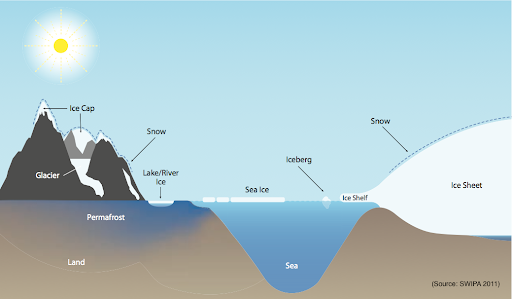
The cryosphere refers to the frozen areas of our planet. It includes sea ice and land ice.
Sea ice is simply frozen ocean water that forms, grows, and melts back into the ocean. Land ice can take many forms, such as glaciers, permafrost, ice sheets, and frozen lakes and rivers (Fig. 2.4.1).
Did you know?
- About 70% of Earth’s freshwater is stored in the cryosphere.
- The cryosphere is home to many species, including polar bears, snow leopards, seals, penguins, and numerous bird species.
- Since ice and snow reflect more heat and sunlight back into space, the cryosphere helps regulate Earth’s temperature and keeps it from getting too hot.
How Is The Cryosphere Measured?
Scientists use several methods to study glaciers and ice sheets.
Satellites measure glacier heights by sending laser beams toward the surface, and calculating how long they take to bounce back. They also detect changes in ice mass by measuring the gravitational pull of large ice sheets.
Research stations in the Arctic and Antarctica allow scientists to directly study the characteristics of ice. These include ice thickness, temperature, ocean currents, ice movement, and the rate of ice formation. They also study sea ice and the surrounding environment using special icebreaker ships that move along with the ice.
Finally, floating buoys equipped with sensors record data such as temperature and salinity of water, which are then transmitted to land.
What Does the Data Tell Us?
Evidence shows that both ice sheets and sea ice are shrinking:
- In Greenland, ice sheets lost an average of 200 gigatons of ice per year between 2003 and 2019.
- In Antarctica, ice sheets lost about 118 gigatons per year during the same period.
In the Arctic, sea ice is also declining.
- Winter sea ice cover has been shrinking by about 3.1% per decade since 1979.
- Usually, Arctic sea ice reaches its minimum in September and grows again during the winter. The summer minimum ice cover has been decreasing even faster—at 13.4% per decade.
It is not only the Arctic and Antarctic regions that are affected. Mountain glaciers across central Europe, western Canada, the U.S., New Zealand, and even the tropics are disappearing at alarming rates.
Now that we’ve examined the extent of changes in the cryosphere, let’s turn to the next major impact of climate change – rising sea levels.