
Climate scientists warn us that if our planet warms 1.5°C (2.7°F) or more, the damage will be irreversible. The issue is that policy and technology take time to implement.
So, what do we do if we cannot act quickly enough? There are two creative ideas that have gained traction in the scientific community. Let’s take a look.
Removing Atmospheric Carbon
We know the most harmful greenhouse gas is carbon dioxide (CO2) because it stays in the atmosphere for a very long time. What if there is a way to capture this greenhouse gas, either before it is released, or pull it directly from the atmosphere?
Scientists have developed technology that can capture CO2 emissions from power plants. Once captured, the emissions are transported through oil pipelines and stored underground. This is known as Carbon Capture and Storage (CCS).
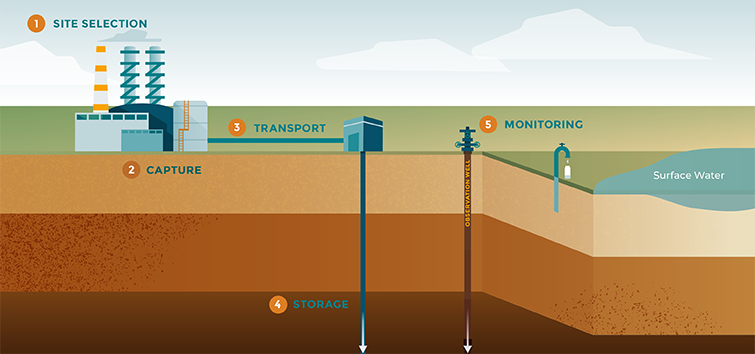
There are a few issues with this technology. It can be expensive to build. Storage reservoirs must be located near power plants, and there is a risk of CO2 leakage. As of 2017, there are at least 21 facilities around the world, and many more are being developed.
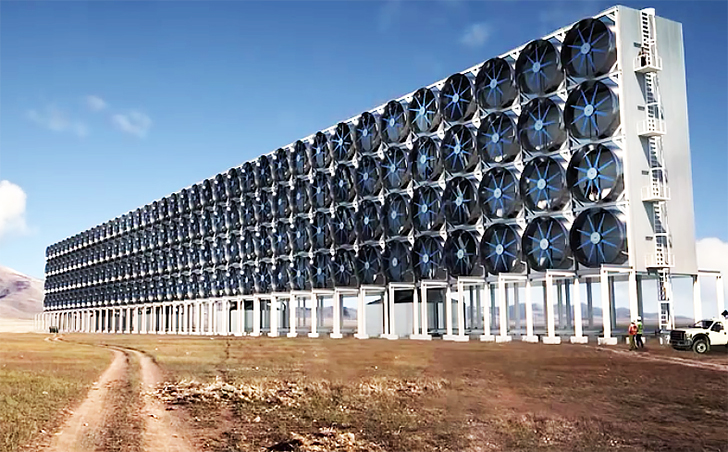
Direct Air Capture (or DAC) is another technology that filters CO2 directly from the air. Once captured, the CO2 is either pumped underground or to a greenhouse where it is used to grow crops.
The gas can also be used by the food and beverage industry, where CO2 can be added to drinks to make them fizzy!
This technology does have its challenges. It consumes a lot of energy and water in the process.
Geoengineering
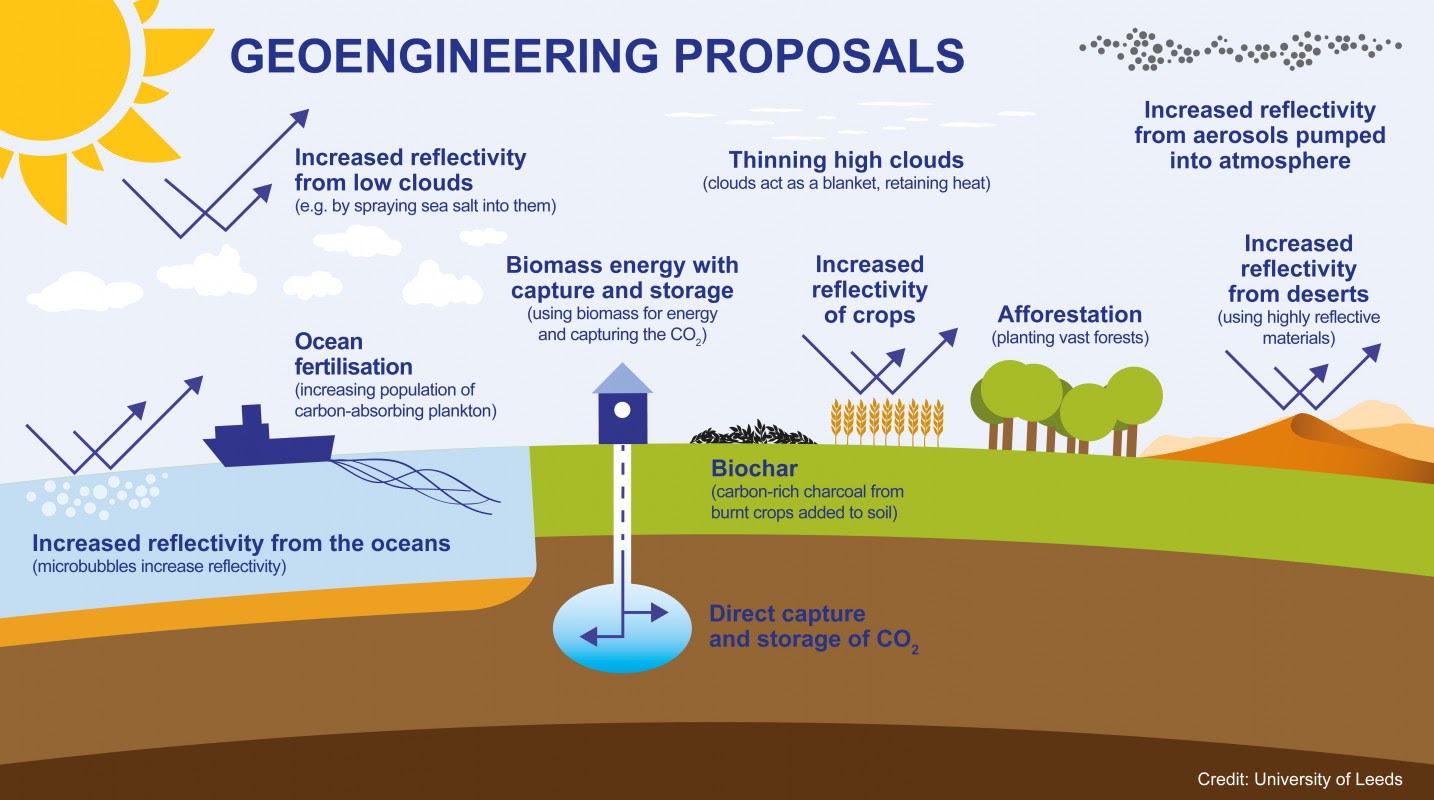
Geoengineering is an attempt to engineer our Earth’s natural processes to reduce global warming (Fig 5.6.3).
Some scientists have thought about spraying sea salt into clouds to make them thicker and more reflective.
Other scientists have suggested thinning cirrus clouds. Cirrus clouds trap the radiation from the Earth and have the same effect as greenhouse gases. Thinning them out would help reduce the greenhouse effect.
There have been other ideas, such as adding nutrients to oceans, where they stimulate the growth of plants and algae that can trap more CO2.
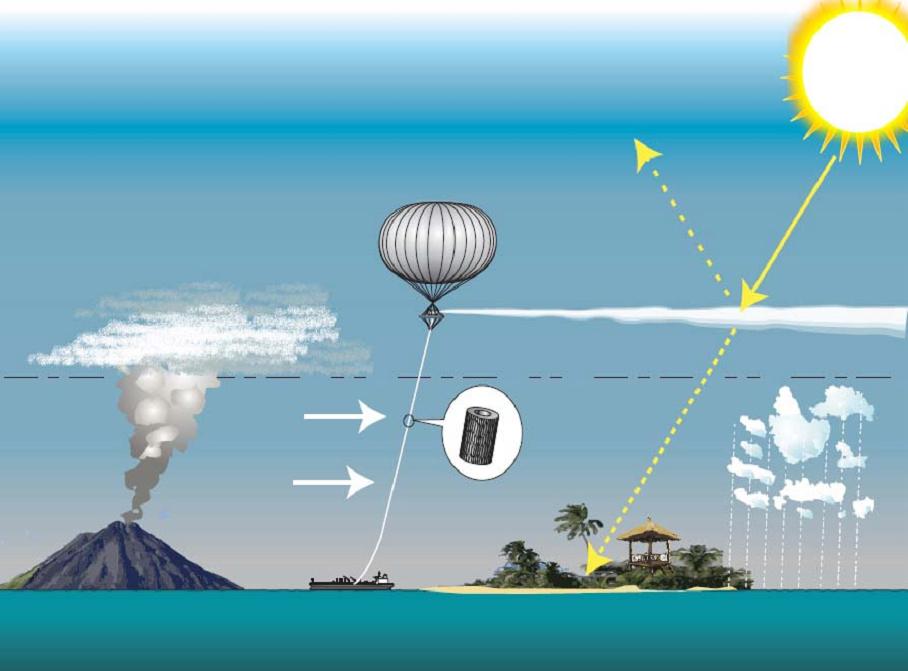
One of the most popular ideas is spraying particles into the stratosphere, similar to a volcano (Figure 5.6.4).
This would have a short-term cooling effect, but it has its drawbacks. The particles would have to be sprayed continuously. If they weren’t replaced right away, our Earth could experience a sudden temperature rise.
Lastly, we don’t know what effects this would have on the weather and natural cycle over time.
All of these are interesting ideas but are ultimately a bandaid for the work we need to do to fix our climate. Scientists continue to encourage government officials and policymakers to act now to prevent the Earth from warming to the point of no return.
So what are governments, companies, and individuals doing to combat climate change? Let’s find out in the next module!
Summary
- Carbon dioxide can be captured before it is released from industries, or directly from the air and stored underground.
- Other futuristic ideas include thinning clouds that trap heat, and growing algae in the oceans to capture carbon dioxide.
- Spraying sulfate particles in the sky can cool the Earth, just as volcanoes do, but there are side effects.
Climate scientists warn that if our planet warms by 1.5°C (2.7°F) or more, the damage could become irreversible. The challenge is that many climate policies and new technologies take time to develop and implement.
So what can we do if we aren’t acting fast enough? Two innovative ideas have gained attention in the scientific community. Let’s explore them.
Carbon Capture and Storage
We know that carbon dioxide (CO₂) has the biggest impact on global warming because it stays in the atmosphere for decades or even centuries. What if we could capture this gas, either before it is released or directly from the air?
Scientists have created technology that captures CO₂ emissions from power plants, transports the gas through pipelines, and stores it deep underground, usually more than 800 meters below the surface. This process is called Carbon Capture and Storage (CCS) and is already being used in many places.
As of 2017, there were at least 21 CCS facilities worldwide; by 2023, that number had grown to more than 700 facilities in operation or under development.
However, CCS has drawbacks. It is expensive to build and maintain. Storage sites need to be located near power plants. There is a small risk of CO₂ leaking back into the atmosphere. Even so, scientists continue to improve the technology, and its use is growing.
Another technology, Direct Air Capture (DAC), removes CO₂ directly from the atmosphere. Companies like Carbon Engineering in Canada and Climeworks in Switzerland are leading the way.
Once captured, the CO₂ can be pumped underground, sent to greenhouses to help plants grow, or used in the food and beverage industry to make carbonated drinks.
DAC uses a lot of energy and water, but progress is being made to make it more efficient.
Geoengineering
Geoengineering is an emerging field that involves altering Earth’s natural systems to slow global warming
Some scientists have proposed spraying sea salt into clouds to make them thicker and more reflective.
Others have suggested thinning cirrus clouds -- the wispy high-altitude clouds that you might see on a clear day. Cirrus clouds trap the infrared radiation from the Earth, and hence, thinning them would reduce the greenhouse effect.
Another idea is adding nutrients to oceans, where they stimulate the growth of plants and algae that can trap more CO2.
Stratospheric Aerosols
One of the most widely discussed ideas involves spraying sulfate particles into the stratosphere to mimic the cooling effect of volcanic eruptions. The effect would be short-lived, but the method has major concerns.
Planes would need to spray particles continuously. If the particles disappear before they are replaced, Earth would experience a sudden temperature rise. Scientists do not fully understand how these particles might affect weather patterns, rainfall, or global ecosystems.
Because of these uncertainties, experts warn that geoengineering is only a temporary “band-aid”, not a long-term fix. It might buy time, but it cannot replace the urgent need for countries and industries to reduce emissions right now.
Now that we’ve explored these cutting-edge technologies, let’s look at how governments, companies, and individuals can work together to drive real, lasting change in the final module!