

Why would someone want to look at climate data? If your grandparents want to live somewhere warm, they might look at the climate of that area to find a warm place.
Lots of people use climate data for planning. Farmers use climate information to decide on what crops to plant. City officials use climate data to prepare for weather events like snowstorms or hurricane season.
Companies that want to build solar or wind farms might look for a place that has a sunny or windy climate.
Governments use climate data for city planning, like maintaining roads or other public needs.
Creating Climate Data
Scientists use basic math to transform daily weather data into climate data.
To find the monthly maximum temperature, scientists add all the daily maximum temperatures. Then they divide the sum by the number of days in the month. This is tracked over a period of 30 years. This gives them a clear picture of the climate over time.
Scientists collect average weather data from multiple weather stations in a region. Some areas have fewer weather stations. In that case, scientists make small changes so the data is more accurate.
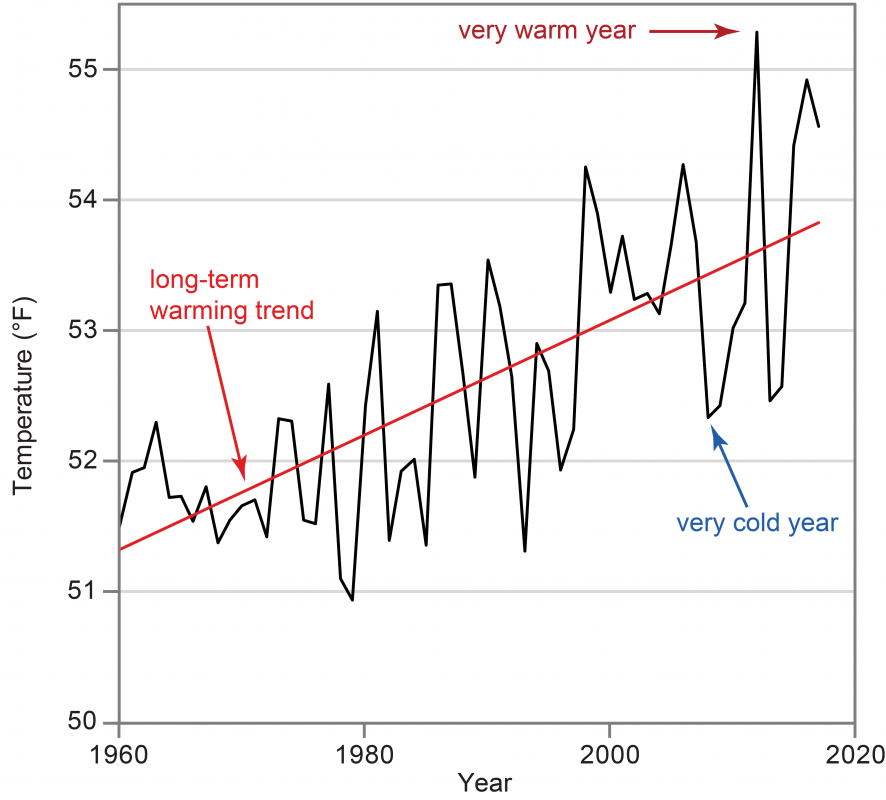
In Fig. 1.3.2, each point on the black line shows the average weather over 365 days in that year.
Each point on the red line shows the average temperature over the previous 30 years. As you can see, while the yearly temperatures are constantly changing, the long-term trend shows temperatures rising.
Organizations such as NOAA track global climate by averaging weather data from around the world.
In the next section, we will look at how scientists use computer models to help make weather forecasts and climate projections.
Summary
- Climate information is used by farmers, companies, governments, and individuals to plan for the future.
- Scientists calculate climate data by “averaging” daily weather data.
- If some areas have fewer weather stations, scientists make adjustments.
Why would someone want to know the climate of an area?
If your grandparents are thinking of retiring somewhere warmer, or if a company is deciding where to build a solar or wind farm, they would depend on climate information to make that decision.
Climate refers to patterns of temperature or precipitation in a particular place over longer periods, typically 30 years or more.
Climate information is used by a wide range of people and sectors, including:
- Farmers, to decide what types of crops to plant and when to plant them for the best yields.
- Water project managers, to decide when and how much water to release from reservoirs.
- Energy companies, to forecast the demand for electricity and costs.
- Governments and businesses, to maintain public infrastructure and prepare for emergencies.
- Public health officials, to study how climate events like flooding influence the spread of waterborne diseases, or how air pollution affects human health.
Creating Climate Data
The process of converting daily weather data into climate data involves basic mathematics.
For example, to calculate the average monthly maximum temperature at a location, scientists add all the daily maximum temperatures for the month. Then they divide the sum by the number of days in the month. This is tracked over a period of 30 years and gives them a clear picture of the climate over time.
To ensure accuracy, scientists collect average weather data from multiple weather stations in a region. They also make adjustments so that areas with fewer weather stations don't distort the data.
Then, there are organizations such as NOAA that compile average weather data from stations across the globe to track global climate patterns.
Take a look at Figure 1.3.2. Each point on the black line represents the average temperature over one year (365 days), while each point on the red line shows the average over the previous 30 years. As you can see, while temperatures fluctuate from year to year, the long-term trend shows temperatures rising.
In the next section, we will explore how scientists use computer models to make short-term weather forecasts and long-term climate projections.